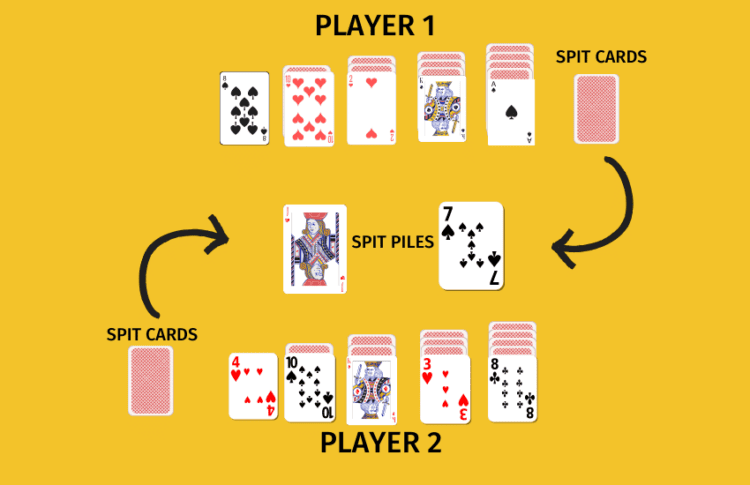
Some card games give you time to think. Speed and Spit do the opposite: they turn a deck into a reflex test where hesitation is basically a mistake. The fun isn’t in “my turn” and “your turn.” The fun is in the tiny panic when you both see a move at once and your hands race before your brain finishes the sentence.
That’s why Speed / Spit card games are still a go-to when people want quick rounds, clean rules, and that satisfying feeling of the table never stopping.
Speed vs. Spit: same DNA, different habits
Players often use the names interchangeably because both are real-time shedding games built on one core idea: play cards onto shared piles as fast as you can when they’re one rank apart. Where they differ is mostly setup and the number of shared piles, plus a few “pause” moments people add to keep things fair.
If you learn one, you’ll understand the other within minutes.
What you need and how to set up fast
You need a standard 52-card deck and a clear table space. Most versions are best with two players, which is why they’re frequently recommended as 2 player card games when you want energy without a full group.
A common Spit-style setup looks like this:
-
Each player gets a personal set of face-down piles (often 5 piles, with 1–5 cards each). The top card of each pile will eventually be turned face up and becomes playable.
-
Each player also has a face-down stock pile (your “hand supply”) to draw from when needed.
-
In the center, create one or two shared “spit piles” (these are the piles everyone plays onto). Many groups start with two.
Don’t stress if your exact pile counts differ from what someone else learned. The engine of the game is the same.
The core rule that drives every move
You can play a card onto a shared pile if its rank is exactly one higher or one lower than the current top card.
Examples:
-
If the top card is a 7, you may play a 6 or an 8.
-
Aces and Kings are handled by house rule: many groups allow A next to 2, and K next to A (wrapping), but some don’t. Decide before you start.
Suits usually don’t matter. Only rank does. That’s why the game feels like pattern recognition at speed rather than a typical trick-taking contest.
How a round actually flows (and why it feels chaotic)
Once the center piles are live, both players play at the same time. There’s no waiting. You scan your face-up cards, spot legal plays, and keep firing them onto the shared piles. As soon as you move a card off the top of one of your personal piles, you flip the next card in that pile (if any) so it becomes available.
Two things happen quickly:
-
The center piles change constantly, creating new legal moves.
-
Your “available” cards shift as you uncover new tops.
If nobody can play, you “refresh” the center by dealing new cards onto the shared piles (the exact method varies: some deal one card each, some flip one per pile). This moment is the game’s only breath—then the sprint starts again.
Winning: what counts as finishing?
Most versions reward the same outcome: you win by getting rid of your cards first.
Depending on the rules your group uses, that might mean:
-
clearing all your personal piles and your stock, or
-
being the first to have no cards left that can be played or flipped.
Because variations exist, the cleanest approach is to agree on one sentence before the first deal: “You win when you’ve fully emptied your side.”
Common variations you’ll see (the ones worth agreeing on)
These are the small differences that cause the most mid-game arguments, so set them early:
-
One shared pile vs two: two piles usually reduces deadlocks and feels smoother.
-
Ace/King wrapping: decide if A connects to K and 2.
-
Simultaneous slap rules: some groups say “first touch wins,” others require the card to be clearly placed.
-
Deadlock refresh: how many new center cards appear when play stalls.
Keep it simple. The best rules are the ones nobody needs to debate while their hands are moving.
A subtle beginner mistake: playing the “obvious” move too early
New players often fire the first legal card they see. That’s natural—and sometimes wrong. In real-time play, sequencing matters because one move can unlock two more… or trap you by removing a useful connector.
A practical habit: when you have two legal choices, prefer the card that keeps your remaining cards more “connected.” Cards in the middle ranks (5–9) tend to act like bridges; dumping them too fast can strand you with awkward gaps.
One human, real-table insight
In casual games—friends, laughter, maybe a cramped coffee table—people misplay less because they “don’t know the rules” and more because they rush the reset moments. When the center piles refresh, take half a second to actually see the new tops. Most beginners lose tempo not during the sprint, but right at the restart, when a clean first move would have given them momentum.
That tiny pause feels slower, but it usually makes you faster overall.
Speed and Spit work because they remove waiting and replace it with constant opportunities: spot a one-rank link, play it, reveal the next card, repeat. Once you agree on a couple of house details, Speed / Spit card games become one of the cleanest ways to turn a deck into a quick, noisy duel—pure motion, minimal downtime, and a surprising amount of skill hiding inside the chaos.
About the Author